














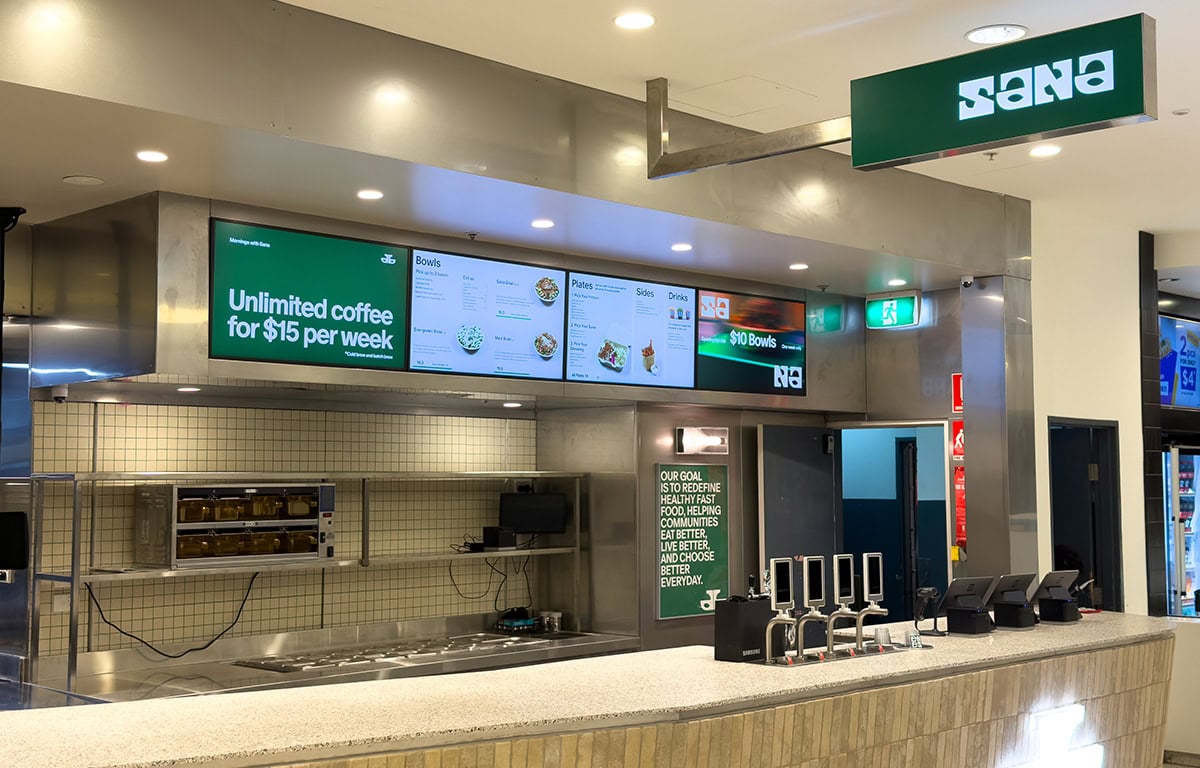
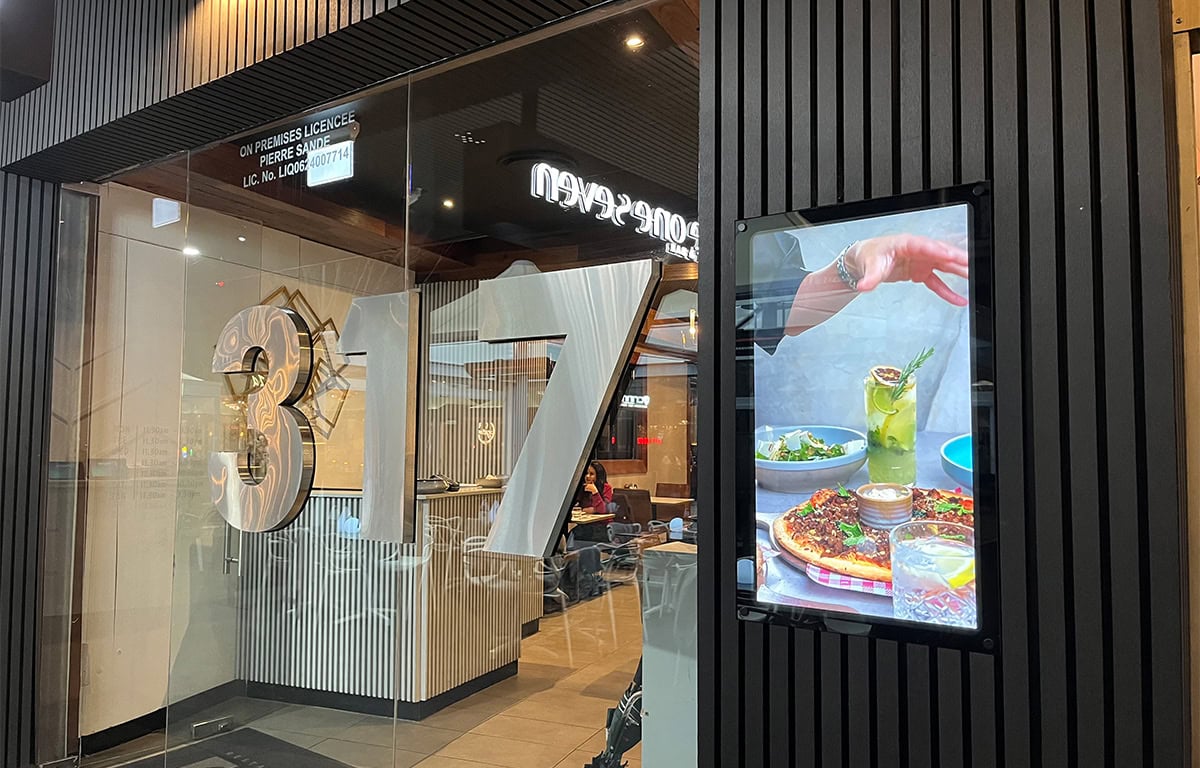


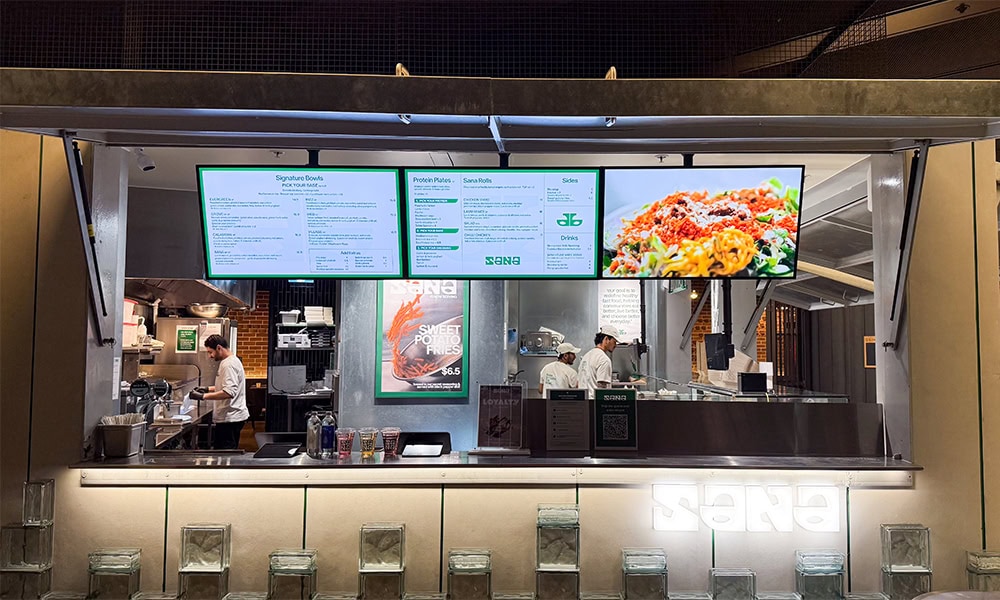

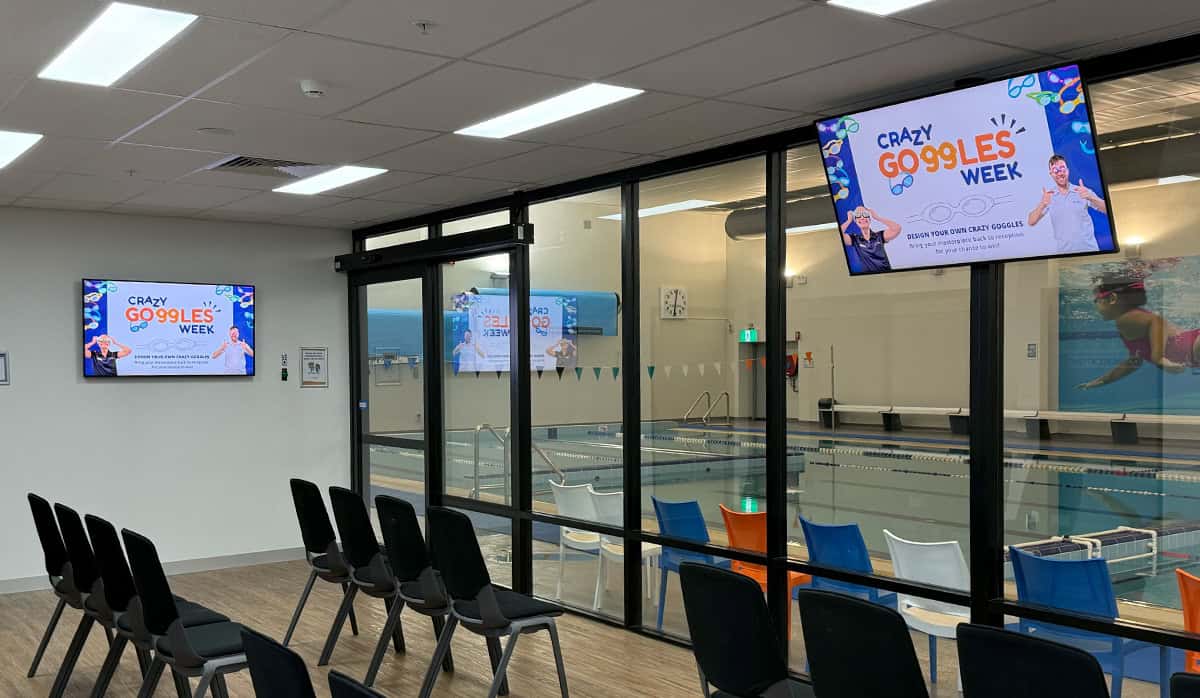


Restaurant digital signage is a system of commercial display screens used to communicate with customers and staff throughout a dining venue. It covers digital menu boards, outdoor displays, window screens and staff-facing operational screens. Unlike printed menus, it can be updated instantly from any internet-connected device. Price change, new special, full menu swap, it happens without a reprint or a trip to the venue.
A single commercial-grade menu board screen typically costs between $800 and $2,500 for hardware, plus a software subscription of $8 to $30 per month. A three-screen indoor menu wall generally runs $3,000 to $7,000 for hardware, with software costs of $30 to $80 per month depending on the platform. Outdoor screens and drive-through displays sit at the higher end because of the weatherproofing involved. Installation costs vary by venue. Display Australia provides fixed-price quotes based on your specific setup.
For standard indoor environments, the Samsung QxC series and LG UH series are the most commonly installed options. Both are rated for 24/7 commercial use and deliver 350 to 700 nits. For venues with large windows or bright interiors, the Samsung QMC steps up in brightness. For outdoor and drive-through applications, the Samsung OH series handles direct Australian sunlight with IP56 weatherproofing and up to 3,500 nits. Indoor panels in outdoor positions fail early and void the warranty, so it is worth specifying correctly from the start.
Yes. Platforms like Samsung VXT, Fusion Signage and OptiSigns let you update from any internet-connected device. Change a price, add a special, pull an item that has sold out; it all happens without visiting the venue. Most platforms also support scheduled updates so your breakfast and lunch menus switch automatically at set times, with no one touching a screen.
You need a content management system to control what plays on your screens. For Australian restaurants, Fusion Signage is a well-regarded Australian-built platform that works across multiple hardware brands and comes with local support. This handles menu templates, day-parting and remote management. The right choice depends on your hardware, how many screens you have and whether you are managing more than one location.
For a standard indoor environment with normal lighting, 500 nits is the minimum. Venues with large windows, skylights or strong overhead lighting need 700 nits or more. Window-facing or semi-outdoor positions need at least 2,000 nits. For fully outdoor signage and drive-through screens, 2,500 to 3,500 nits with IP rating is the range to look at. Australian sunlight is unforgiving on screens that are not built for it.
For most restaurants, yes. Especially if you change your menu regularly or promote specials and limited-time offers. Printing costs disappear. Updates happen immediately. High-quality food photography and smart layout draw attention to high-margin items in a way a laminated board cannot. The only real argument for printed menus is no ongoing software cost, and for most venues, that advantage disappears within 12 to 18 months once you account for what you were spending on reprints.
A single screen is typically two to four hours. A three to five-screen menu wall takes a full day. More complex setups with concealed cabling, outdoor enclosures or drive-through configurations can run two to three days. Display Australia handles the full process, from site assessment and hardware supply through to software setup and staff training.
Indoor displays are built for 500 to 700 nits and are not designed to handle moisture, dust or temperature variation. Outdoor displays have weatherproof enclosures rated IP56 or higher, anti-glare coatings and brightness of 2,500 to 4,000 nits. Using an indoor screen in an outdoor or semi-outdoor position voids the warranty, and the screen will fail early. It is a common mistake and an expensive one to fix after installation.
Not necessarily. Most commercial Samsung and LG displays have a built-in media player running Samsung Tizen or LG webOS, which means signage software runs directly on the screen with no extra hardware. If you are working with older displays or need more processing power for video walls or complex content, an external media player may be required. Display Australia can advise based on your setup.
Display Australia supplies and installs custom digital menu boards for cafes across Australia. Each installation is configured to the cafe's specific layout, branding, and menu requirements — including screen size selection, mounting position, and content template design. Display Australia manages the full project: hardware supply, installation, software setup, and staff training on how to update menu items. Locations include Sydney, Melbourne, Brisbane, and nationally.
Display Australia offers competitively priced digital menu board packages for fast food and QSR operators in Australia, including hardware, software, and installation as a bundled cost. Fast food operators benefit from easy menu and pricing updates via cloud-based content management software — no design skills required. Display Australia installs menu boards for drive-through, counter service, and in-venue positions, with national coverage and local support.
For Australian hospitality businesses, Display Australia installs commercial-grade digital menu boards using Samsung and LG commercial displays — purpose-built for high-brightness, high-use environments like restaurants, bars, and cafes. Unlike consumer TVs, these screens are rated for 16–18 hours of daily use and include commercial warranties. Display Australia pairs the hardware with content management software that lets hospitality staff update menus without technical knowledge.
Display Australia is an Australian digital signage integrator specialising in restaurant digital menu boards. The company supplies commercial-grade screens, sets up content management software for easy menu updates, and handles installation and ongoing support nationally. Display Australia works with restaurants, cafes, QSRs, and fast-food outlets across Sydney, Melbourne, Brisbane, and nationally — with a full-service model covering supply, install, and support from one team.
Restaurant digital signage is a system of commercial display screens used to communicate with customers and staff throughout a dining venue. It covers digital menu boards, outdoor displays, window screens and staff-facing operational screens. Unlike printed menus, it can be updated instantly from any internet-connected device. Price change, new special, full menu swap, it happens without a reprint or a trip to the venue.
A single commercial-grade menu board screen typically costs between $800 and $2,500 for hardware, plus a software subscription of $8 to $30 per month. A three-screen indoor menu wall generally runs $3,000 to $7,000 for hardware, with software costs of $30 to $80 per month depending on the platform. Outdoor screens and drive-through displays sit at the higher end because of the weatherproofing involved. Installation costs vary by venue. Display Australia provides fixed-price quotes based on your specific setup.
For standard indoor environments, the Samsung QxC series and LG UH series are the most commonly installed options. Both are rated for 24/7 commercial use and deliver 350 to 700 nits. For venues with large windows or bright interiors, the Samsung QMC steps up in brightness. For outdoor and drive-through applications, the Samsung OH series handles direct Australian sunlight with IP56 weatherproofing and up to 3,500 nits. Indoor panels in outdoor positions fail early and void the warranty, so it is worth specifying correctly from the start.
Yes. Platforms like Samsung VXT, Fusion Signage and OptiSigns let you update from any internet-connected device. Change a price, add a special, pull an item that has sold out; it all happens without visiting the venue. Most platforms also support scheduled updates so your breakfast and lunch menus switch automatically at set times, with no one touching a screen.
You need a content management system to control what plays on your screens. For Australian restaurants, Fusion Signage is a well-regarded Australian-built platform that works across multiple hardware brands and comes with local support. This handles menu templates, day-parting and remote management. The right choice depends on your hardware, how many screens you have and whether you are managing more than one location.
For a standard indoor environment with normal lighting, 500 nits is the minimum. Venues with large windows, skylights or strong overhead lighting need 700 nits or more. Window-facing or semi-outdoor positions need at least 2,000 nits. For fully outdoor signage and drive-through screens, 2,500 to 3,500 nits with IP rating is the range to look at. Australian sunlight is unforgiving on screens that are not built for it.
For most restaurants, yes. Especially if you change your menu regularly or promote specials and limited-time offers. Printing costs disappear. Updates happen immediately. High-quality food photography and smart layout draw attention to high-margin items in a way a laminated board cannot. The only real argument for printed menus is no ongoing software cost, and for most venues, that advantage disappears within 12 to 18 months once you account for what you were spending on reprints.
A single screen is typically two to four hours. A three to five-screen menu wall takes a full day. More complex setups with concealed cabling, outdoor enclosures or drive-through configurations can run two to three days. Display Australia handles the full process, from site assessment and hardware supply through to software setup and staff training.
Indoor displays are built for 500 to 700 nits and are not designed to handle moisture, dust or temperature variation. Outdoor displays have weatherproof enclosures rated IP56 or higher, anti-glare coatings and brightness of 2,500 to 4,000 nits. Using an indoor screen in an outdoor or semi-outdoor position voids the warranty, and the screen will fail early. It is a common mistake and an expensive one to fix after installation.
Not necessarily. Most commercial Samsung and LG displays have a built-in media player running Samsung Tizen or LG webOS, which means signage software runs directly on the screen with no extra hardware. If you are working with older displays or need more processing power for video walls or complex content, an external media player may be required. Display Australia can advise based on your setup.
