
Learn where to place digital screens in retail stores for maximum impact. Optimise your in-store digital signage from the window to the point of sale.
In the world of physical retail, we often spend huge amounts of time and energy on product selection, shop fit-outs, and staff training. Yet, when it comes to technology, many retailers fall into a common trap: they buy a screen first, and figure out where to put it later.
This "field of dreams" approach, build it and they will come, rarely works with digital screens in retail stores. A beautiful 4K display hidden behind a pillar, or a menu board mounted so high that customers have to crane their necks to read it, is an investment that will never pay off.
The effectiveness of retail digital signage is largely determined by its location. A screen is not just a piece of furniture; it is a communication channel. Just as you wouldn't have a salesperson stand in the storeroom shouting about special offers, you shouldn't place your digital assets where they can’t be seen or heard.
To get the most out of your technology, you need to map your store’s ecosystem. You need to understand customer flow, sightlines, and "dwell time." This guide will walk you through the four critical zones of retail and explain where digital screens in retail work best to drive engagement and sales.
For businesses ready to move beyond placement strategy to a complete retail digital signage solution, Display Australia supplies and installs commercial screens across Australia.
Before we start drilling holes in the walls, it is vital to understand the psychology behind screen placement. The goal of digital screens in retail stores is to deliver the right message, to the right person, at the right time.
If you display detailed product specifications at the store entrance, customers will ignore them; they are moving too fast. If you display a simple "Welcome" message at the checkout, you are wasting a prime upselling opportunity; the customer is already captivated and waiting.
Australian retailers often operate in spaces with unique constraints, heritage buildings in Melbourne laneways, bright glass boxes in Gold Coast shopping centres, or expansive showrooms in industrial estates.
The 45-Degree Rule: Research suggests that shoppers naturally scan a store at a 45-degree angle as they walk. Screens placed flat against a side wall might be missed entirely. Angling screens towards the flow of traffic is often more effective.
The Eye-Level Imperative: The most valuable real estate in any store is eye level (roughly 1.4m to 1.7m off the ground). Placing a screen too high (above 2.2m) often renders it invisible to the shopper's subconscious. Unless it is a large-format video wall intended for distance viewing, keep your content where the eyes are.
The first battlefield is the lease line. Whether you are in a Westfield or on a high street, your first job is to stop the customer from walking past.
This is your "hook." The objective here isn't to educate; it is to disrupt.
The Strategy: Use high-brightness screens (2,500+ nits) to combat the Australian sun. Static posters fade and blend into the background. Motion cuts through the visual noise.
The Content: Keep it bold, fast, and visual. Avoid text. Think of fashion retailers like Bailey Nelson, who utilise high-brightness screens to show models moving and wearing frames. The movement in peripheral vision triggers a biological response in passersby, causing them to turn their heads.
The "Decompression Zone" Warning: Retail psychology tells us that the first 2-3 metres inside a store is the "decompression zone." Customers are adjusting from the mall environment to your store environment. They are taking off sunglasses, slowing their pace, and orienting themselves. Do not put complex interactive screens here. Customers will breezily walk past them. Instead, use large-format screens or video walls further back that act as a visual anchor, drawing them through this zone and into the store proper.
Once the customer is browsing, their mindset shifts. They are no longer rushing; they are evaluating. This is where digital screens in retail stores transition from "shouting" to "consulting."
The ends of your aisles are prime real estate. Shoppers naturally pause here to turn corners.
The Strategy: Use smaller screens (32” to 43”) mounted at eye level. This is the place for "Silent Selling."
The Content: Problem/Solution videos. If you are selling power tools, show the drill going through concrete. If you are a pharmacy, show the application of a skincare product. This validates the purchase for a customer who might be hesitant to ask a staff member for help.
One of the biggest challenges for brick-and-mortar stores is limited floor space. You can't stock every colour of every sneaker.
The Strategy: Place an interactive touch screen near the relevant product category.
The Content: Allow customers to scan a barcode and see what other sizes or colours are available online for home delivery. This saves the sale that would otherwise be lost to a competitor.
For retailers with larger items, like automotive accessories, furniture, or appliances, standard screens might be too small.
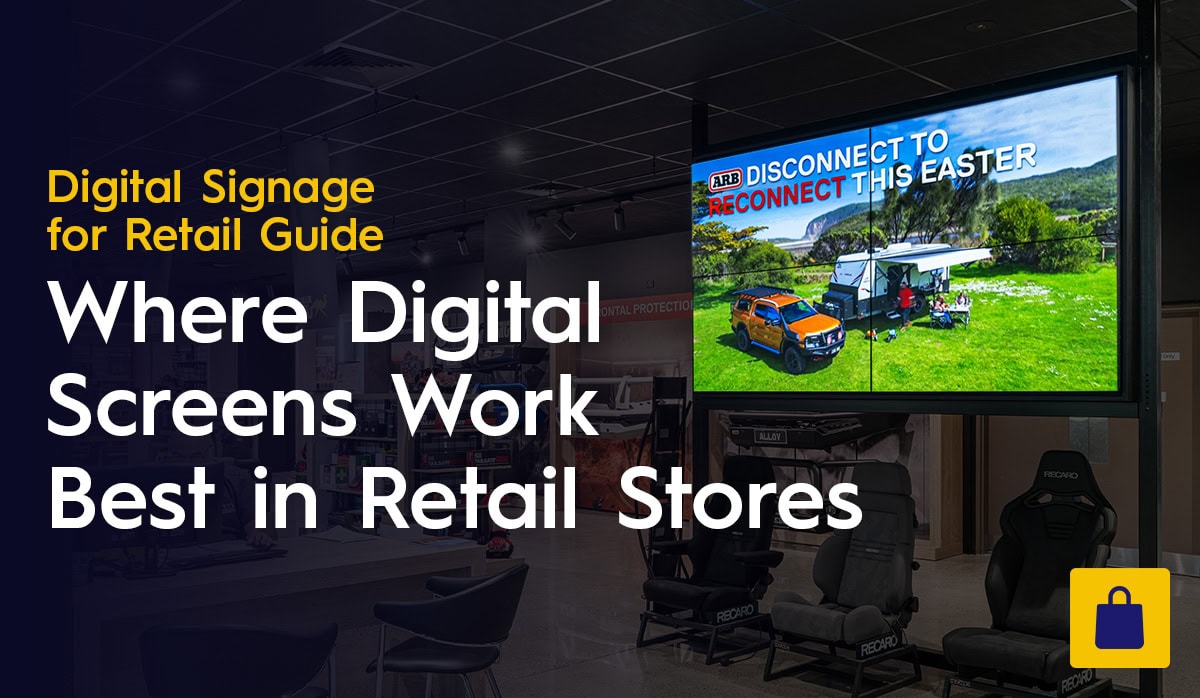
Use Case: Automotive retailer ARB utilises 2x2 video walls in their showrooms. When a customer is looking at a static bull bar on a rack, it can be hard to visualise its value. By placing a massive video wall nearby playing 4K footage of a truck crossing a river, the screen provides the context. It shifts the customer's focus from the price of the metal to the value of the experience.
The counter is the holy grail of retail. The customer has decided to buy, but the transaction isn't over yet. This is where in-store digital signage delivers its highest Return on Investment (ROI) via upselling and queue management.
For QSR (Quick Service Restaurants), cafes, and bakeries, this is non-negotiable.
The Strategy: Use commercial screens mounted in portrait or landscape high above the staff, but tilted down (5-10 degrees) to meet the customer's eyeline.
The Content: Use "Day-Parting." As seen with Sana Mediterranean, digital screens allow you to automatically flip content based on the time of day. You don't need to waste screen space showing breakfast rolls at 2:00 PM. This clarity speeds up the ordering process.
The Upsell: Use animation to draw the eye to high-margin add-ons. A static picture of a Coke is fine; a video of a Coke with condensation dripping down the glass and fizzy bubbles popping triggers a thirst response that drives impulse purchases.
Don't neglect the small space right next to the EFTPOS terminal.
The Strategy: A small 10-inch or 22-inch screen facing the customer while they wait for the staff to scan items.
The Content: This is the perfect place for "Join our Loyalty Program" prompts. The customer is idle for 30-60 seconds. This is a captive audience. It is also an ideal spot to reinforce return policies or warranty upsells without the staff member feeling awkward asking for it.
While we often focus on the customer, digital screens in retail are powerful tools for managing your team, particularly in larger stores or franchises.
The traditional corkboard in the staff tea room is usually a mess of torn paper and outdated rosters.
The Strategy: Install a standard 50-inch TV connected to your digital signage network.
The Content: This becomes your internal news channel.
Why it works: It keeps casual and part-time staff, who might not check company emails, in the loop. It builds culture and ensures everyone is aligned on the day's targets before they step onto the floor.
For retailers with a heavy "Click and Collect" volume, a screen in the back-of-house can display pending orders.
The Strategy: Integration with your POS or inventory system.
The Content: A dashboard showing new orders as they come in, colour-coded by urgency. This reduces the time staff spend checking distinct computer terminals and keeps the packing workflow moving efficiently.
Once you have identified your zones, keep these practical installation tips in mind to ensure your screens look professional.
Hide the Cables: Nothing ruins the illusion of high-tech retail like a black power cord dangling down a white wall. Ensure you have power and data points installed directly behind the screen position before you mount the bracket.
Mind the Glare: In Australian retail, natural light is abundant. If you are placing a screen opposite a window, you must choose a panel with a high "haze" rating (matte finish) or high brightness to prevent it from becoming a mirror.
Portrait vs Landscape: Don't default to landscape (horizontal) just because that’s how TVs look at home. In retail, Portrait (vertical) often works better on pillars and walls because it mirrors the shape of the human body and fashion imagery, and it takes up less horizontal wall space.
The placement of digital screens in retail stores is not an exact science, but it is certainly strategic. It requires you to walk your floor not as an owner, but as a customer.
Start at the front door. Where do your eyes naturally go? Where do you pause? Where do you wait? These are the locations where a screen will add value. By placing high-impact screens in your windows, educational content in your aisles, and dynamic purchasing triggers at your point of sale, you transform your store from a static warehouse of goods into a dynamic, persuasive environment.
Whether you are a single boutique looking to add a touch of modern class, or a national chain like ARB looking to immerse customers in a lifestyle, the right screen in the right place is the key to unlocking the full potential of digital signage.
