
Shopfront digital signage helps retailers grab attention, promote offers, and increase foot traffic using bright, high-impact window displays.
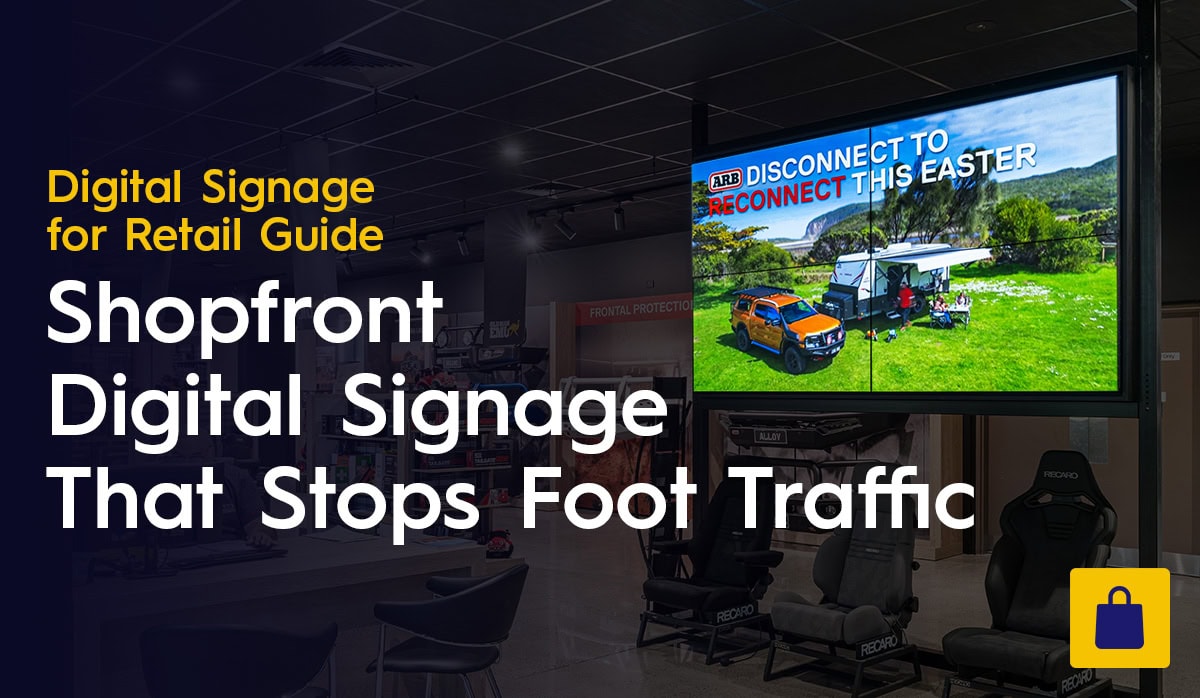
Every retailer knows the struggle. You watch hundreds of people walk past your store every day. They look at their phones, they look straight ahead, or they look at the coffee in their hand. They simply do not look at your shop window.
In the competitive landscape of Australian retail, the battle for attention is won or lost in the first three seconds. This is the window of opportunity you have to stop a passerby, engage their interest, and convince them to walk through your door. Traditional printed posters and static mannequins are no longer enough to break through the visual clutter of a modern high street or shopping centre.
This is where shopfront digital signage changes the game. By replacing static images with vibrant, high-definition video that moves and adapts, you create a powerful "pattern interrupt" that forces people to look. It transforms your window from a passive display into an active marketing channel that works for you twenty-four hours a day.
However, installing a screen in a window is not as simple as hanging a TV on a wall. It requires specific hardware, a thoughtful strategy, and an understanding of the unique lighting conditions found in Australia. This guide will explore everything you need to know about retail window digital screens, from technical brightness requirements to the content strategies that actually drive foot traffic.
Shopfront digital signage refers to commercial-grade digital displays specifically installed in window cavities or facing outwards towards the street. Unlike the standard digital screens you might find behind a service counter, these units are purpose-built to perform in the toughest environment in retail: the shop window.
To the untrained eye, they might look like standard televisions. In reality, they are vastly different pieces of technology. A standard TV or even a standard commercial indoor screen will fail in a window environment for two reasons. First, it will not be bright enough to be seen. Second, the heat generated by direct sunlight hitting the panel will cause the liquid crystals to boil, turning the screen black and permanently damaging the hardware.
Dedicated window digital signage is engineered to overcome these challenges. These screens are often three to ten times brighter than a standard screen. They feature advanced cooling systems and UV-resistant panels that can withstand temperatures up to 110 degrees Celsius on the LCD surface. They are designed to run 24/7, allowing you to advertise your brand to late night foot traffic long after your staff have gone home.
Why are so many Australian retailers, from fashion boutiques like Bailey Nelson to large format showrooms, switching to digital windows? The investment offers returns that static signage simply cannot match.
The human eye is biologically hardwired to detect motion. It is a survival instinct. When a person walks past a row of static shop windows, their brain filters out the background noise. If your window features movement, such as a model twirling in a dress or a slow-motion pour of a coffee, it triggers a reflex. The shopper looks. Once you have their attention, you have a chance to convert them. Research consistently shows that digital displays capture significantly more views than static signs.
In retail, speed is money. With traditional print signage, launching a new promotion is a slow process. You have to design the poster, send it to the printer, wait for delivery, and then physically install it. If you spot a mistake or want to change the offer, you have to start all over again.
With shopfront digital signage, you can change your entire window display in seconds. Did a sudden rainstorm hit? You can instantly display a promotion for umbrellas and raincoats. Did you just receive a delivery of a viral product? You can have a photo of it in your window before the delivery truck has even left the loading dock. This agility allows small businesses to react to market trends faster than major department stores.
While the upfront cost of a high-brightness screen is higher than a poster, the long-term savings are substantial. Think about how much you spend on printing, shipping, and installing window decals and posters over a three-year period. Add to that the cost of staff time spent changing the displays. A digital screen is a one-time hardware cost. Once installed, your "printing" costs drop to zero. You can run fifty different campaigns in a year for the same operational cost as running one.
Your lease is expensive. You pay for your shopfront 24 hours a day, so why only market during trading hours? A printed poster is invisible at night unless you have expensive external lighting. A digital screen, however, is a beacon.
In the evening, when the rest of the shopping strip is dark, your retail window digital screens are vibrant and glowing. They capture the attention of people walking to restaurants, leaving bars, or just window shopping after hours. You can program the content to shift in the evening, perhaps showing a "Shop Online" QR code or simply building brand awareness so they remember to come back the next day.
This is the most critical technical section of this guide. If you ignore this advice, your project will likely fail.
The success of shopfront digital signage relies entirely on visibility. In Australia, our sunlight is harsh and intense. Standard screens simply cannot compete with the sun.
Brightness is measured in a unit called "nits" (candela per square metre).
A standard home TV: Approx 250 to 350 nits.
A standard commercial indoor screen: Approx 500 to 700 nits.
A high brightness window screen: 1,500 to 4,000 nits.
If you put a 500 nit screen in a shop window facing the street, it will look washed out and dim. On a sunny day, it will be completely invisible, acting more like a mirror that reflects the street behind the viewer. To cut through the glare of the sun, you absolutely need a screen that is rated High Brightness.
The specific brightness you need depends on which way your window faces.
South Facing Window: These windows get indirect light. You might get away with a "semi high brightness" screen of around 1,000 to 1,500 nits.
North or West Facing Window: These windows face the full force of the Australian sun. You must use a screen with at least 2,500 to 3,000 nits. Anything less will be unreadable.
Another factor to consider is sunglasses. Many Australians wear polarised sunglasses to reduce glare. Standard LCD screens emit polarised light. If the polarisation of the screen conflicts with the polarisation of the sunglasses, the screen will appear completely black to the wearer.
Premium window digital signage from brands like Samsung (OM series) or LG (XS series) includes special "quarter wave plate" technology. This circular polarisation ensures that the content remains visible even to customers wearing polarised sunglasses. This is a vital feature for high street retailers in coastal or sunny locations.
You do not want your screen blasting 3,000 nits of brightness at night. It would be blinding to drivers and waste enormous amounts of electricity. Quality window screens come with built-in ambient light sensors. They automatically adjust their brightness based on the environment. They pump out maximum power at noon when the sun is high, and dim down to a comfortable glow after sunset.
Once you have the right hardware, you need the right strategy. The rules for shopfront digital signage content are different from in store screens. You have less time to make an impact.
People are walking past your store at a brisk pace. You have approximately three seconds to convey your message. Do not use paragraphs of text. Do not use complex explanations.
Bad Content: A list of ten bullet points explaining your return policy.
Good Content: A bold video of a product, a headline "50% OFF", and a clear "IN STORE NOW" call to action.
Your screen is competing with reflections, traffic, and street noise. Subtlety does not work here. Use high contrast colours. White text on a black background or bright yellow on blue works well. Ensure your font size is massive. If someone cannot read the headline from ten metres away, it is too small.
Static images on a digital screen are a wasted opportunity. You need movement.
Fashion: Show the fabric moving. Show the model walking.
Hospitality: Show the steam rising from the food. Show the drink being poured.
Service: Show a time-lapse of the service being performed.'
Even if you only have static photos, use your content software to add gentle zooming or panning effects (Ken Burns effect) to create a sense of life.
Do not give everything away in the window. The goal is to get them inside.
The Idea: "Unlock Your Secret Offer Inside."
Why it works: It creates curiosity. Instead of just displaying the price, you invite the customer to enter the store to find out more. This physical commitment of walking through the door increases the likelihood of a sale.
Turn your window into a 24-hour store.
The Idea: Display a large QR code with the text "Closed? Shop Online Now."
Why it works: It captures the sale even when your doors are locked. It caters to the window shopper who might love the product but can't buy it right now because you are closed.
Before you rush out to install your new shopfront digital signage, there are some boring but essential logistical boxes to tick.
In Australia, local councils can be strict about digital signage that faces the street, particularly if your store is near a road. Flashing lights or rapidly changing colours can be deemed a driver distraction.
The Fix: Check your local council's signage policy. Generally, smooth transitions and slow moving video are acceptable, while strobe effects or rapid flashing are prohibited. You may need to apply for a signage permit, just as you would for a physical awning sign.
These screens are heavy. A 75-inch high-brightness screen in a steel enclosure can weigh over 50 kilograms. Standard aluminium window frames or Gyprock ceilings may not be able to support this load.
The Fix: You will likely need a floor-to-ceiling mount or a structural reinforcement in the ceiling. Consult with a professional AV installer who can assess the structural integrity of your shopfront.
We mentioned earlier that these screens get hot. If you enclose the screen in a tight box to make it look neat, you might suffocate it.
The Fix: Ensure there is adequate airflow around the intake and exhaust vents of the screen. If you are building it into a cabinet or a bulkhead, you may need to install active extraction fans to pull the hot air away from the device.
Even the brightest screen can struggle if the sun hits the glass window directly.
The Fix: Consider the angle of installation. Sometimes tilting the screen slightly downwards can reduce reflections from the sky. Alternatively, applying an anti-glare film to the shop window glass can improve visibility significantly.
Shopfront digital signage is one of the most powerful tools available to modern retailers. It reclaims the wasted real estate of your window and turns it into a dynamic, 24/7 sales machine. It signals to the street that your brand is modern, relevant, and open for business.
However, success requires more than just enthusiasm. It requires the right high-brightness hardware to combat the Australian sun. It requires punchy, motion-based content that respects the three-second rule. And it requires professional installation to ensure safety and compliance.
By investing in quality retail window digital screens, you stop relying on luck to get customers through the door. You take control of your street presence, grabbing attention and driving the foot traffic your business needs to thrive. The technology is ready. The only question is, what will you display to stop the crowd?
