
Explore retail digital signage case studies and real-world examples showing how stores use digital screens to attract customers and increase sales.
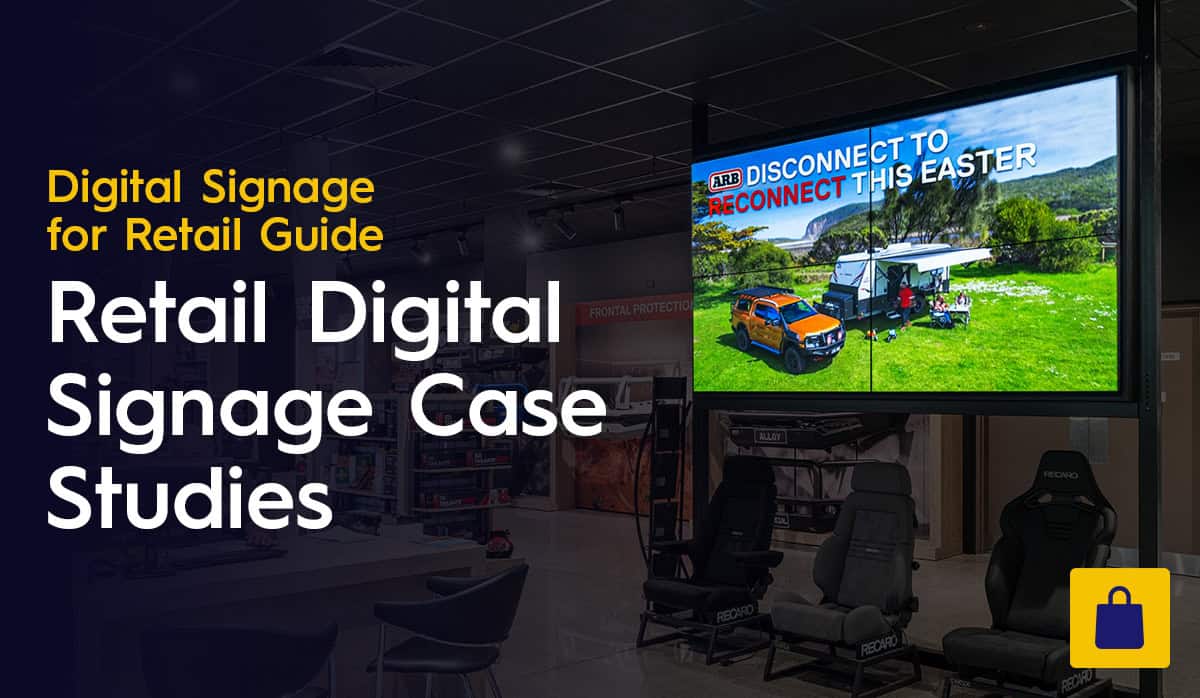
In the fast-moving world of retail, business owners are naturally sceptical of new trends. We see shiny new technologies arrive with great fanfare, only to fade away a few years later. For every successful innovation like tap-and-go payments, there is a failed experiment that costs retailers thousands of dollars.
It is easy to read about the theoretical benefits of digital screens. We can talk about increased engagement and operational efficiency until the cows come home. However, nothing builds confidence quite like seeing it in action. Store managers and owners want proof. They want to see how businesses just like theirs are actually using the technology to solve real problems and drive real revenue.
A retail digital signage case study offers more than just a success story. It provides a blueprint. It shows the specific challenges a brand faced, the hardware and software choices they made to solve them, and the tangible results they achieved.
In this guide, we will move beyond the theory and look at two distinct Australian examples. We will explore how a single-site fashion retailer in Parramatta used a custom installation to elevate their brand, and how a global eyewear giant manages a complex network of screens across three continents. These retail digital signage examples prove that whether you have one store or one hundred, the principles of success remain the same.
Before diving into the specific examples, it is important to understand why reviewing a retail digital signage case study is a vital part of your buying process.
Investing in digital signage is a significant capital expenditure. Unlike buying a coffee machine or a new vacuum cleaner, a digital signage network requires integration with your shop fit-out, your IT network, and your marketing strategy.
Case studies help de-risk this investment in three key ways.
First, they validate hardware choices. Seeing that a major retailer uses a specific type of screen for their north facing windows gives you confidence that the same screen will work for your shopfront.
Second, they offer design inspiration. Many retailers struggle to visualise how a screen will look in their store. Seeing photos of a 75 inch screen recessed into a custom timber cabinet helps you imagine how similar joinery could work in your space.
Third, they highlight potential pitfalls. A good case study often hints at the challenges faced during installation, such as data cabling issues or structural support requirements, allowing you to plan for these hurdles in advance.
One of the most common misconceptions is that digital signage is only for big box retailers with massive budgets. The project at The Good Kid in Parramatta proves that single-site retailers can achieve a world-class result with the right strategy.

The Good Kid is a premium streetwear retailer located in the busy Westfield Parramatta shopping centre. They had just completed a highly successful branding campaign and wanted to carry that momentum into their physical store.
The challenge was aesthetic integration. The store features a sleek, minimalist fit-out. Simply bolting a television to the wall would have looked cheap and essentially ruined the premium atmosphere they had worked so hard to create. They needed a digital surface that felt like a permanent architectural feature rather than an appliance.
The team at Display Australia consulted with the owners and shopfitters to design a bespoke solution. Instead of a standard wall mount, they opted for a massive 75-inch Samsung Commercial Display.
Crucially, the screen was not just hung on the wall. The shopfitter built a custom enclosure specifically designed to house the display. This meant the screen sat flush within the joinery, hiding all cables, mounts, and bezels.
From a technical perspective, they utilised the Samsung VXT system. This is a cloud-based Content Management System (CMS) that runs directly on the screen's internal computer. This eliminated the need for an external media player, keeping the installation clean and allowing the owners to update the content remotely via Wi-Fi.
The result is a stunning visual anchor that stops shoppers in the mall. The sheer size of the 75-inch screen commands attention, while the custom enclosure ensures it feels like a high-end part of the store design.
This retail digital signage example demonstrates that for small businesses, the "fit and finish" is just as important as the technology. By treating the screen as a piece of furniture rather than just a TV, The Good Kid created a premium touchpoint that validates their price point and enhances the customer experience.
Scaling digital signage from one store to a global network introduces a completely new set of logistical challenges. Bailey Nelson, the Australian eyewear success story, provides a perfect case study on how to manage this complexity across borders.

Bailey Nelson has grown rapidly, with stores now operating across Australia (NSW, QLD, VIC), New Zealand, and Canada. This expansion presented a two-fold problem for their marketing team.
Firstly, they had to manage brand consistency across thousands of kilometres. A sales campaign launching in Sydney needed to go live in Vancouver at the exact same time, but with a different currency (AUD vs CAD). Relying on USB sticks and local staff to update screens was impossible.
Secondly, their store environments varied wildly. Some stores were inside dark shopping centres, while others were high street boutiques with windows facing direct sunlight. A "one size fits all" screen approach would not work.
Display Australia worked with Bailey Nelson to implement a "hybrid" hardware strategy underpinned by a unified software platform.
They did not just buy one type of screen. They audited each location to choose the right tool for the job.
Indoor Stores: For stores inside centres like Bondi Junction, we utilised Samsung QMC series displays. These screens are slim, elegant, and bright enough (500 nits) to stand out under artificial mall lighting without being overpowering.
Street Front Locations: For locations with windows facing the sun, high-brightness commercial displays are used. These units pump out 1,500 to 4,000 nits of light, ensuring the content cuts through the glare and remains visible to passersby even on a sunny Queensland afternoon.
To tie these different screens and different countries together, they deployed Fusion Signage. This Australian-developed CMS is cloud-based, meaning the Head Office team can log in from anywhere to manage the fleet.
This approach solved both the logistical and environmental challenges.
Global Control: The marketing team can now push a button to deploy a new campaign globally. The software allows them to "tag" screens by region. When they upload a price list, the system automatically sends the AUD version to Australian screens and the CAD version to Canadian screens.
Visual Impact: By using high-brightness screens in the windows, Bailey Nelson ensures their beautiful video content of models wearing the frames is actually seen. They didn't waste money putting standard screens in windows where they would look black.
Efficiency: The rollout was streamlined. By standardising the mounting systems and using commercial-grade panels with 3 year warranties, they reduced the long term maintenance burden on their IT team.
While The Good Kid and Bailey Nelson operate at very different scales, their digital signage retail success stories share several common outcomes. These are the tangible benefits that any retailer, regardless of size, can expect from a well-executed project.
Both case studies rely on visual attraction. Whether it is the 75 inch screen at The Good Kid or the high brightness window screens at Bailey Nelson, the primary goal is to stop the customer in their tracks. The motion and brightness of digital displays act as a "pattern interrupt," breaking the shopper's gaze and drawing them towards the lease line.
Both businesses moved away from the "USB stick" mentality. By using cloud-based software (Samsung VXT and Fusion Signage), they removed the need for staff to physically touch the screens. This saves hours of labour and ensures that expired promotions are removed instantly, protecting the brand from pricing errors.
Perhaps the most important outcome is the perception of quality. In both cases, the screens were integrated thoughtfully into the shop fit-out. They weren't an afterthought. This attention to detail signals to the customer that the brand is modern, professional, and premium. It builds trust before the customer even speaks to a sales assistant.
So, what can you learn from these retail digital signage case studies? If you are planning your own rollout, here are the key takeaways to ensure your project is a success.
Do not just buy the cheapest screen. If you have a window, you must pay for high brightness. If you have a dark corner, a standard screen is fine. Using the wrong hardware will result in a display that is unreadable and a waste of money.
Take a leaf out of The Good Kid's book. Don't just slap a screen on a wall with visible cables. Work with your shopfitter or a professional AV installer to recess the screen or build a custom enclosure. The screen should look like it belongs in the store, not like a temporary addition.
You might think you can manage one screen with a remote control, but what happens when you open your second store? Or your third? Investing in a proper Content Management System (CMS) from day one sets you up for scalable growth. It allows you to manage your marketing from your laptop, giving you the freedom to focus on running your business.
Both examples rely on great content. A static image on a digital screen is a waste of potential. Use video. Show your product in motion. Whether it is a streetwear model walking down a runway or a closeup of eyewear frames turning in the light, movement is what captures attention.
The evidence is clear. Retail digital signage case studies from across Australia demonstrate that this technology is no longer a gimmick. It is a fundamental part of modern store design.
Whether you are a single boutique looking to make a statement like The Good Kid, or a multinational chain looking for consistency like Bailey Nelson, the path to success follows the same rules. Choose commercial-grade hardware that suits your environment, use cloud software to manage it efficiently, and integrate it seamlessly into your store's architecture.
By following the lead of these successful retailers, you can invest with confidence, knowing that your digital signage network will deliver real business value for years to come.
